Hani Mansour
Professor of Economics | University of Colorado Denver | IZA@Liser Research Fellow | CESifo Research Fellow
I am an applied economist with research spanning labor economics, economic demography, and the economics of gender. My work examines the labor market effects of immigration enforcement, the career progression of female politicians, and the economics of marriage and family formation. My articles have been published in leading journals including the Review of Economics and Statistics, Economic Journal, Journal of Labor Economics, the Journal of Human Resources, and the Journal of Development Economics.
Contact: hani.mansour@ucdenver.edu



Sample of Recent Research
Adjustments to Reduced Cash Transfers: Religious Safety Nets and Children's Long-Term Outcomes. Revise and Resubmit at the Journal of Political Economy.
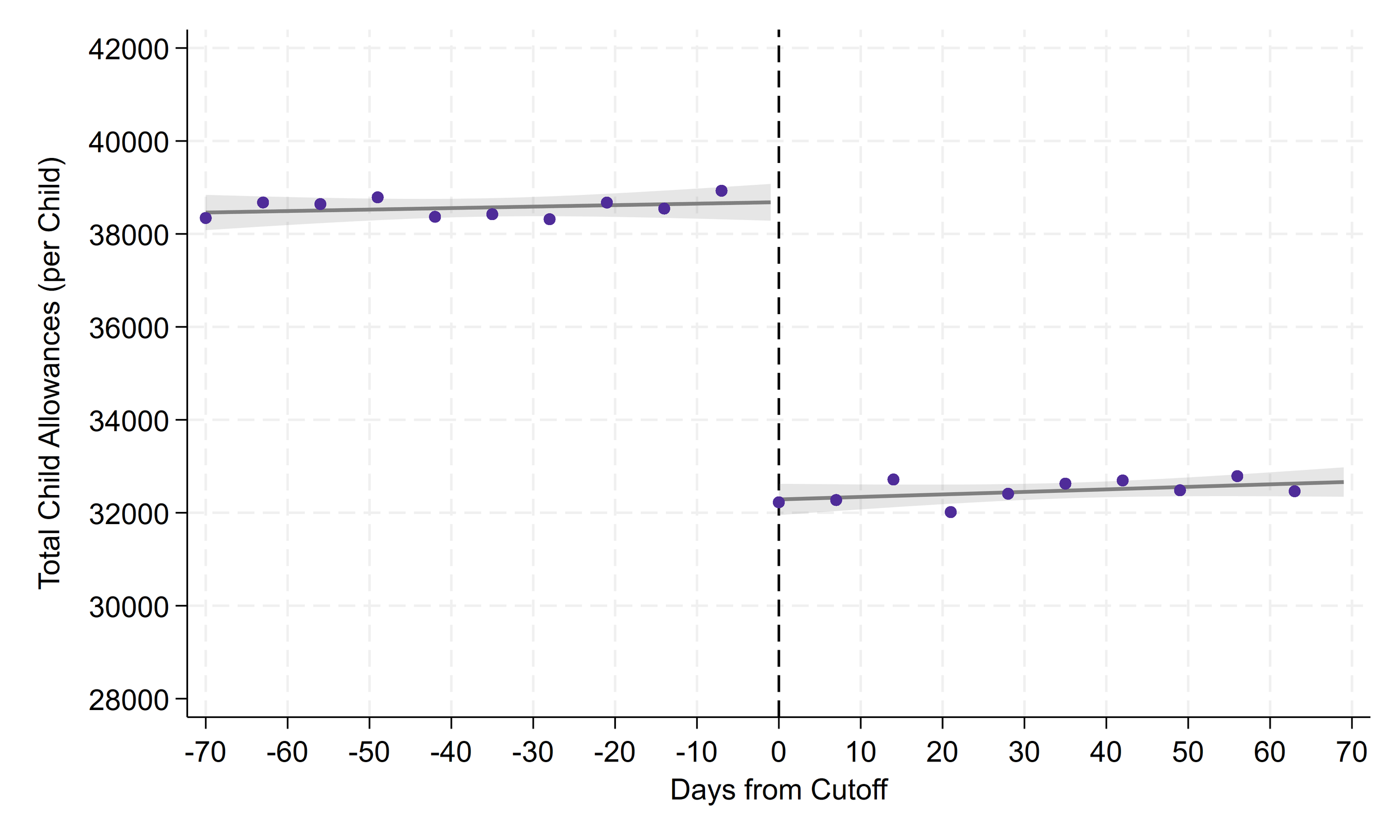
Abstract: This paper examines how families adjust to changes in unconditional cash transfers, and how these adjustments affect children's long-term outcomes. In 2003, Israel reformed its child allowance program, significantly reducing unconditional cash benefits for large families. Using a sharp date-of-birth cutoff introduced by the reform, we show that Arab families responded by reducing completed fertility and increasing paternal employment. Consequently, we find little evidence that the decline in transfers negatively affected the education or labor outcomes of Arab children. In contrast, Jewish families substituted for the loss in government benefits by enrolling their school-aged children in ultra-Orthodox religious schools, without changing their fertility or labor supply. These schools act as informal safety-nets by providing valuable services unavailable in mainstream public schools but focus primarily on religious studies over secular subjects. In the long run, this substitution between formal and informal safety nets resulted in lower educational attainment among Jewish students and may have steered them toward a more religious lifestyle. Our results highlight the importance of existing support structures in determining the effects of policy changes, particularly in contexts where religious and public welfare systems compete.
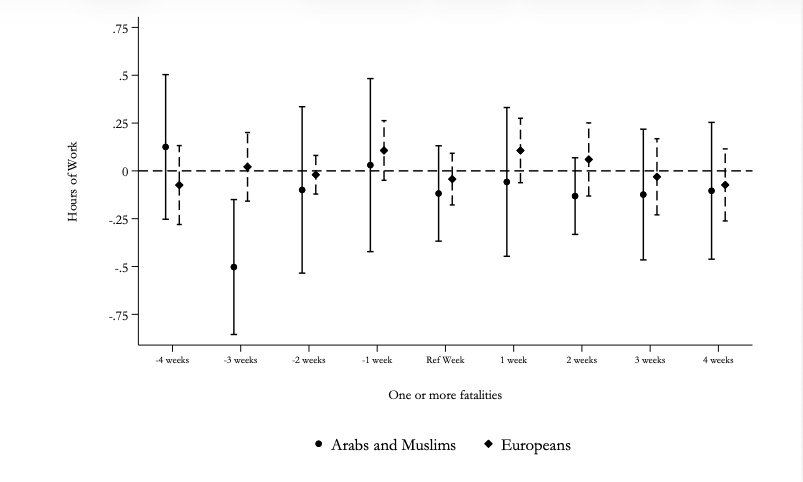
Abstract: This paper shows that members of a disfavored group adjust their economic behavior in response to prejudice. We exploit localized increases in anti-Arab and anti-Muslim sentiment triggered by combat fatalities of U.S. service members during the wars in Afghanistan and Iraq (2001–2014). Following a home-state fatality, Arab and Muslim men reduce weekly hours worked by about 1 percent. The decline reaches 3.7 percent during multiple-fatality weeks among the self-employed and workers in interactive occupations. These responses coincide with short-lived increases in anti-Muslim hate crimes. Our findings indicate that prejudice distorts market outcomes by inducing targeted individuals to withdraw from economic interactions.
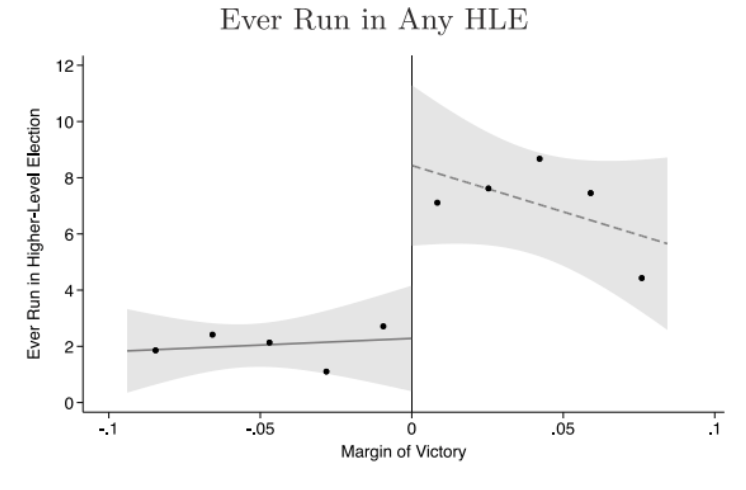
Abstract: This paper quantifies the gender gap in the returns to electoral success on the career progression of novice U.S. state legislators. Using a regression discontinuity design, we find that narrowly winning a state legislature election doubles the probability that a female politician will later compete for a higher-level legislative seat compared to narrowly elected male politicians. While the gender gap in the effect of local political experience on winning a higher-level election also favors women, it is not precisely estimated. The gender difference in the effect of winning state a legislature seat is larger when serving in positions that closely resemble the responsibilities and workload of higher-level positions. We conclude that the pathway from local to higher-level political offices functions at least as effectively for women as for men. Therefore, supporting the recruitment, funding, and campaigning of women in local elections can be an effective strategy to increase their representation at the highest levels of government.
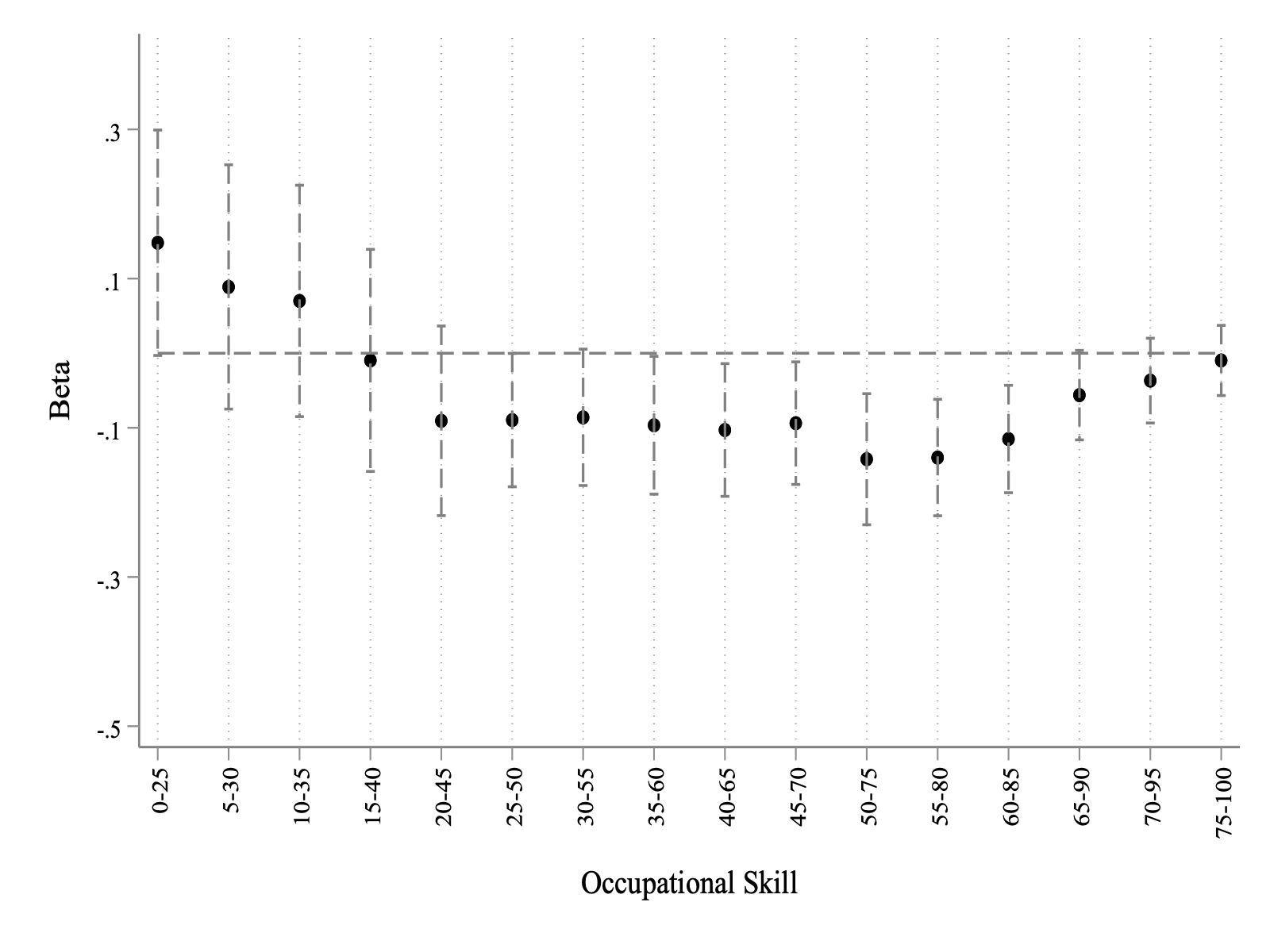
Abstract: This paper examines the labor market effects of Secure Communities (SC)--a police-based immigration enforcement policy implemented between 2008-2013. Using variation in implementation across local areas and over time, we find that SC decreased the employment of likely undocumented immigrants. These effects are driven not only by deportations, but also by adjustments among immigrants who remain in the U.S. Importantly, SC also decreased the employment and hourly wages of U.S.-born individuals. We provide support for two mechanisms that could explain this decline in labor demand: an increase in labor costs that decreases job creation, and a reduction in local consumption.